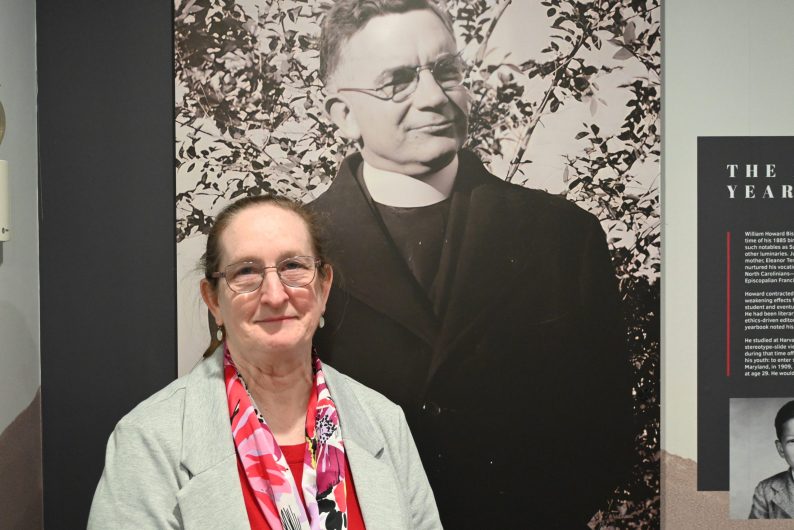
“A Who’s Who of Catholicism.” This is how Lucy Putnam, archivist for Glenmary Home Missioners, describes the diaries of Father William Howard Bishop, the apostolic society’s founder. “It’s truly fascinating to read through the diaries as Father Bishop talks about meeting with the head of Maryknoll Publishing, clergy of various orders who would later become bishops, archbishops, and popes,” says Putnam.
Father Bishop’s diaries begin in 1915, his year of ordination, continue through 1919, then start again in 1933 until his death in 1953. “In the 1920s we don’t have many diaries because he was one of the founding members of the Catholic Rural Life Conference, an initiative to serve the rural Church, which necessitated extensive travel.
Throughout the diaries “what struck me is how committed he is to starting Glenmary. The combination of his connections and his 20 years of ministry in rural Maryland dealing with limited incomes and budgets, doing more with less are just immeasurable,” Putnam relates.
The diaries were first transcribed in the 1970s. Two years ago, an effort began to further annotate the writings to provide historical context for people, events, words, and history. “In the first set of diaries (1915–1919), Father Bishop is referencing all these things that are going on during World War I and how that’s impacting his ministry. As you get further into the 20th century, he talks about calling people ‘long distance,’ having an operator intercede in a phone call or getting a collect call, refers to his first car as a ‘machine,’ and a 200-mile trip which took him eight hours.”
Father Bishop’s tenacity under many obstacles is evident in the diaries. “As he’s forming GHM, WWII breaks out. He can’t get a building permit, because everything is going toward the war. Several prospective students join the armed services because Pearl Harbor is bombed,” notes Putnam.
The diaries also humanize Father Bishop — “he’s referencing a brother in the Armed Services; as one of seven children, he’s helping to take care of his nieces and nephews, his siblings, his mother.”
The first three volumes, up to 1936, are bound and self-published. “The guys are reading them at morning prayer. For many who’ve only been exposed to bits and pieces of the story, the diaries show the struggles and challenges Father Bishop had to wrestle with,” says Putnam.
Almost nine decades later, GHM remains true to Father Bishop’s founding principles. “It does ebb and flow and change through Vatican II as lay ministers have taken on a larger role, but Father Bishop would have welcomed that. He was a very ‘cutting edge’ person,” Putnam adds.
Putnam calls Father Bishop’s vision “a light in the darkness. Since 1939, over 160 missions have been cared for and returned to dioceses. We’ve worked in more than a dozen dioceses, in 14 states. It’s been immensely successful.”