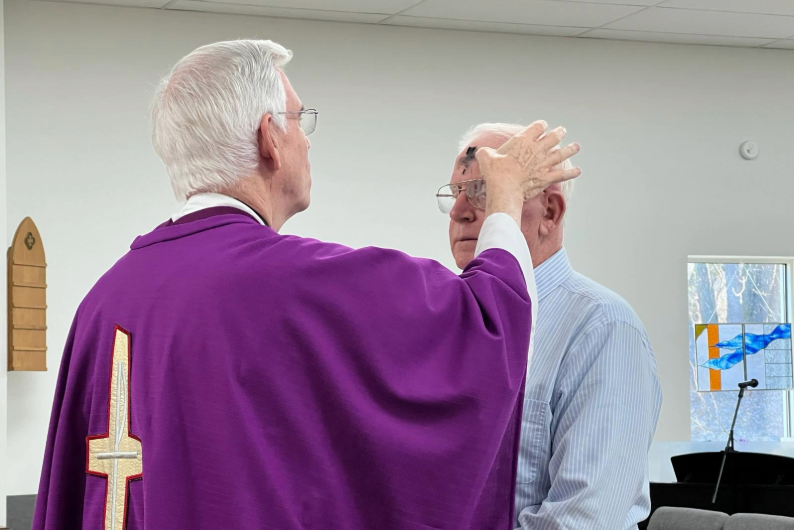
Lent is a season in the Church calendar, meant to prepare our hearts for the death and resurrection of Jesus Christ. The season lasts 40 days, beginning on Ash Wednesday and ending at sundown on Holy Thursday.
In the Gospel we hear proclaimed on Ash Wednesday, Jesus speaks to his disciples about prayer, fasting, and almsgiving. These practices are known as the three pillars of Lent and act as guidelines on how we can refocus our spiritual lives during this season.
Prayer
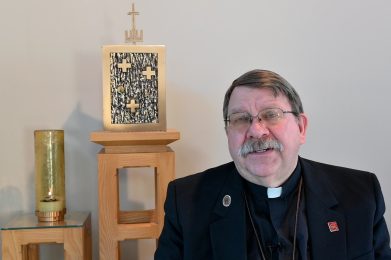
There are many distractions in our daily life, says Father Chet Artysiewicz. “We need to keep our focus sharp as we try to follow Jesus, follow his word, his gospel, and love one another.” Prayer helps us keep that focus day-to-day.
“One of the most precious things we have is our time, because it’s limited only to so many days, hours, months, years,” says Father Chet. “Whatever we give our time to is something that we really deem as precious and worthwhile.” Prayer is spending time with God, just as you would make time for a friend or loved one.
The act of prayer can look different for everyone. “Sometimes it’s verbal. Sometimes it’s no more than being in the very presence of God,” says Father Chet. The Church offers us several ways to pray, like the rosary, Divine Mercy Chaplet, Eucharistic Adoration, and Liturgy of the Hours.
“I know you’ve seen that bumper sticker that goes: Prayer changes things,” says Father Chet.
“In a sense, it does. Because prayer changes us. Prayer changes people, and people change things.”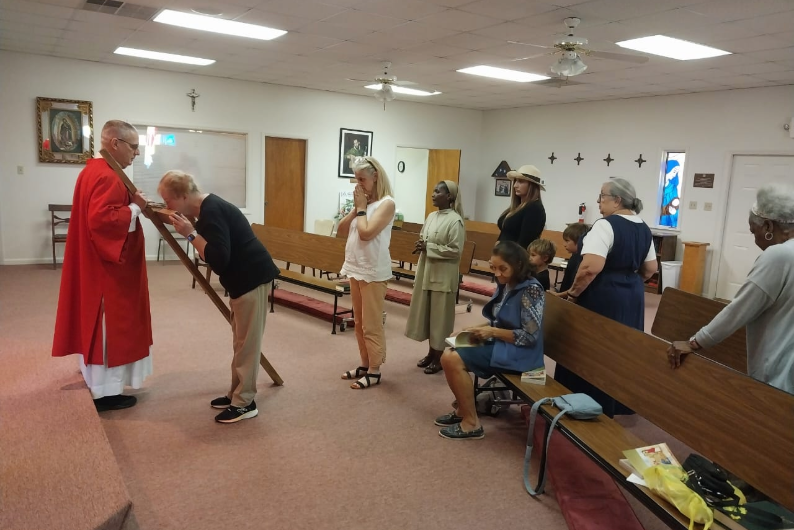
Fasting
During the season of Lent the Church asks the faithful to fast in two special ways. The first is fasting from food on Ash Wednesday and Good Friday, which is asked of those who are age 18 and older. “When fasting,” says the US Catholic Bishops, “a person is permitted to eat one full meal, as well as two smaller meals that together are not equal to a full meal.”
The second form of fasting is to abstain from meat on the seven Fridays during Lent for those aged 14 and older.
Many Catholics also choose an additional fast during the season of Lent. “What are we fasting from?” asks Father Tom Charters. “I would say fast from that which is a barrier in your life” preventing you from having a better relationship with God and with others.
If you’re spending too much time on your phone or on social media, Father Tom suggests fasting from that for an hour or two a day. Pray for someone you dislike or think about them in a positive way. “Maybe I need to fast to have a different attitude toward other people” like a spouse, family member, or politician.
Father Tom recalls a time when he was in grad school, “there was a family from Cincinnati that was saying ‘hate’ all the time. And, so they decided during Lent that every time they said the word ‘hate,’ they had to put some money into this big bowl.” The parents as well as the children, one who was only four years old, took part in the activity.
“At the end of Lent, they stopped saying ‘hate,’” says Father Tom. “And they gave us the money for a tabernacle in our house of study in St. Louis.”
Almsgiving
According to the catechism, almsgiving is “a witness to fraternal charity” and “a work of justice pleasing to God.” (2462).
“For me,” says Father Kenn Wandera, “almsgiving is that we remember that our life and our faith is actually in connection with other people. And so we give something of ourselves; we share what God has given us with other people.”
Almsgiving can mean making monetary donations toward those in need, but it can also mean acts of service. Volunteering at a local nonprofit or even spending time with someone in a nursing home can be an act of service.
“Central to our Catholic faith is always that we are in solidarity with other people and especially those in need,” says Father Kenn. “So sharing what we have with others, that I think defines what almsgiving is.”
Almsgiving is highlighted during the Lenten season, but the faithful are encouraged to continue practicing it year-round. “I’ve said this before, that the Catholic Church teaches that our faith is never ours, it’s not a private affair,” says Father Kenn.
“And so I hope that it’s not just a time that we do this and then we move on, afterwards when Easter and Lent is done, but something that reminds us this is what defines a pilgrim: people that give of themselves to others to share.”
Partner with us in sharing God’s love where it’s needed most. Donate today.